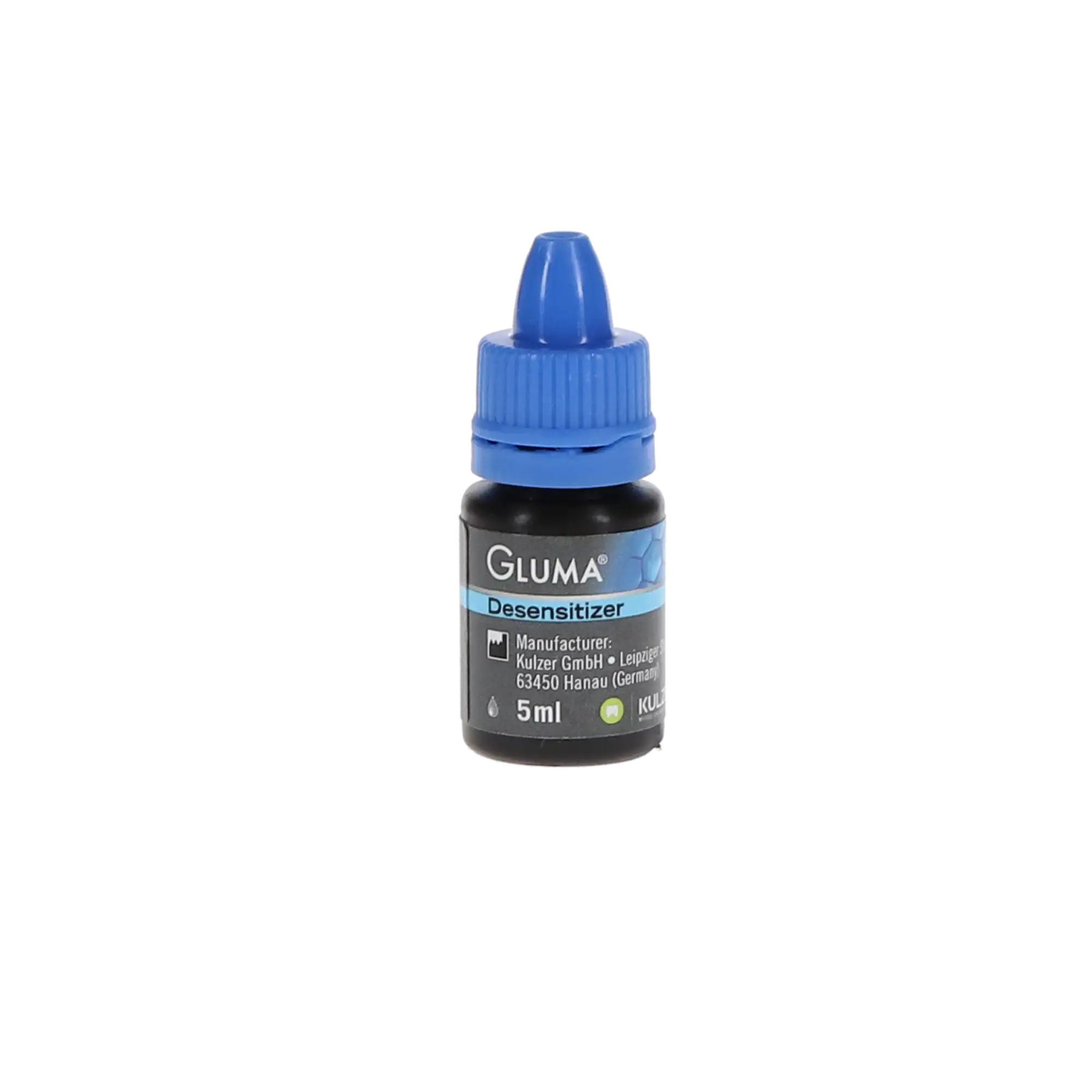
- Glutaraldehyde-based dentin desensitizer
- No mixing or curing required
- Fast, effective relief in one drop
- Compatible with all bonding and restorative materials
- Reduces microleakage, improves bond strength
- Quantity: 1 x 5 mL Bottle
Kulzer Gluma Desensitizer, Standard Bottle Refill is used for treating cervical hypersensitivity and eliminating dentinal hypersensitivity, giving clinicians a simple, one-step chairside desensitizer with no mixing and no curing. When a patient reports lingering sensitivity after a restorative procedure or after crown and bridge preparation, one drop of Gluma on the exposed dentin gives fast, effective relief before the appointment continues.
The same desensitizer is used as a pretreatment before priming and bonding direct composite restorations.Each pack contains 1 bottle of desensitizer at 5 mL. The solution contains 5% glutaraldehyde and 35% hydroxyethyl methacrylate (HEMA), and it is a self-cured liquid that needs no mixing, no curing, and no repeated steps. It is compatible with all bonding and restorative materials in any situation, including direct composite restorations, compomer restorations, and amalgam restorations.
Because the bottle needs no mixing or curing, one drop is placed, air-dried to a matte surface, and the restorative sequence continues. Application is quick enough to fold into a restorative or hygiene visit, and a single 5 mL bottle serves many patients.The desensitizer works through its two active ingredients. The glutaraldehyde reacts with serum albumin in the fluid of the dentinal tubules and precipitates it, forming plugs that partly occlude the tubules, and the HEMA carries the reaction into the tubule and helps stabilize the plug.
The solution penetrates exposed tubules up to 200 microns and forms a seal that acts as a microbial barrier. It is applied to the dentin as a single drop and works within about a minute. Beyond treating existing sensitivity, the desensitizer is used before priming and bonding for direct composites, before compomer or amalgam restorations, and before crown and bridge cementation and bonding, so the same bottle fits the restorative workflow without a change of adhesive system, and the treatment can be repeated at a later visit if sensitivity returns.